

Mesoscale eddies are swirling vortices of water 10s to 100s of kilometres wide that are a key feature of ocean circulation. As eddies move across the ocean, they distort local water properties, featuring warmer or cooler sea surface temperatures than the surrounding environment. They also impact ocean physics, deepening or shallowing the surface layer of the water column. Small ocean fronts are created around the outside of eddies that trap plankton and small animals near the surface. Many studies have now linked these ocean features to enhanced phytoplankton productivity and an elevated abundance of marine animals.
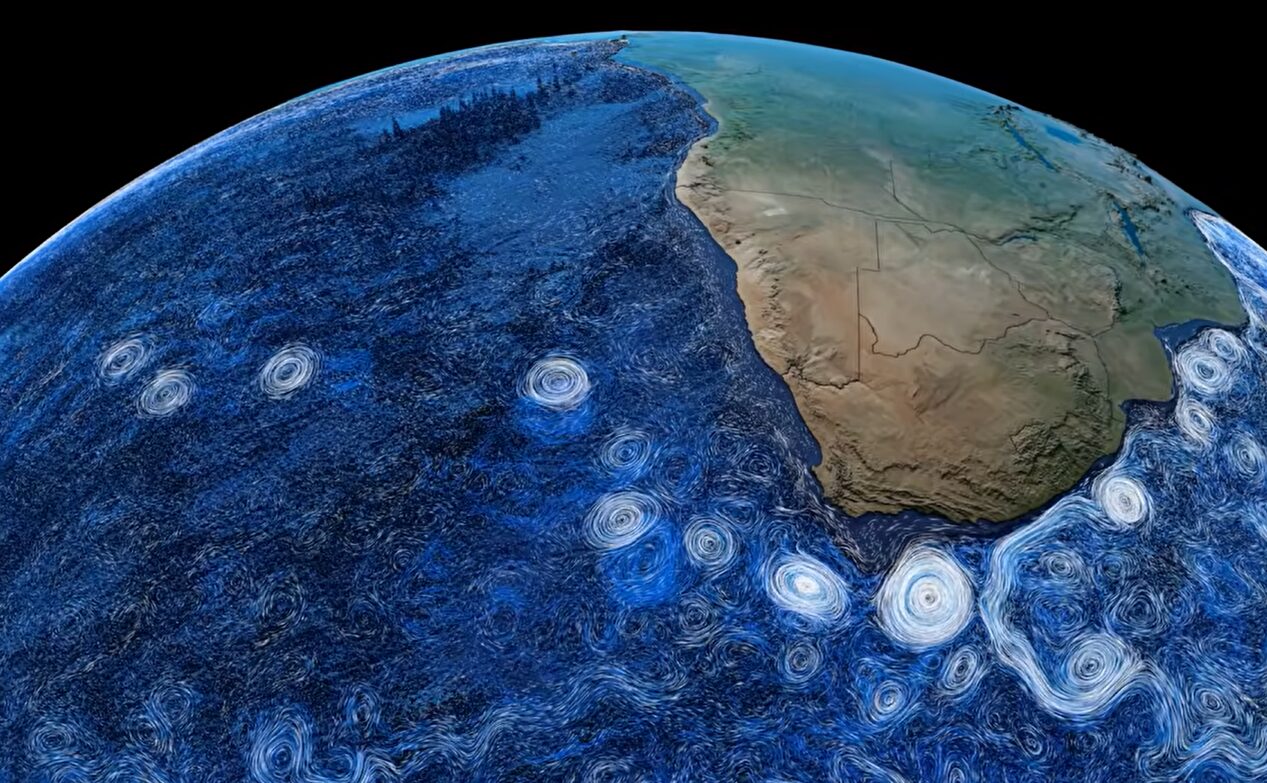
A series of mesoscale eddies visualised from NASA ECCO model, off the coast of Southern Africa. © NASA Goddard Space Flight Center (still from: Kathleen Gaeta Greer, Josh Willis& Greg Shirah. (2025). An Ocean in Motion: NASA’s Mesmerizing View of Earth’s Underwater Highways. Zenodo. https://doi.org/10.5281/zenodo.16782525)
In our recent study in Progress in Oceanography, we sought to understand whether eddies impact foraging trips made by penguins, and whether this effect was seen for different species living in different areas across the Southern Ocean. To do this, we collated penguin tracking data for five penguin species (Emperor, King, Chinstrap, Adélie, and Macaroni penguins) from 59 different breeding colonies, using data stored in repositories like the Seabird Tracking Database and the Retrospective Analysis of Antarctic Tracking Data.
For each of 3189 individual tracks, we identified slow, non-linear movements indicative of foraging, and related these behaviours to the local distribution of eddies. We then classified penguins from each colony during each unique breeding stage as those that use eddies (specialised), those that might use eddies but we can’t be sure (possible use), and those that do not use eddies (unspecialised).

A group of King Penguins, one of the five species we studied alongside Adélie, Chinstrap, Macaroni, and Emperor penguins. © Ondrej Prosicky, Shutterstock
We found that eddies influenced penguin foraging trips in 38% of our case studies, with a possible influence in a further 20%. Similar percentages were seen for all five species, but we detected a lesser influence of eddies on penguins in Tierra del Fuego, the Antarctic Peninsula and South Shetland Islands than those in other regions. Additionally, we found a greater influence of eddies when penguins experienced central place foraging constraints during the breeding season.
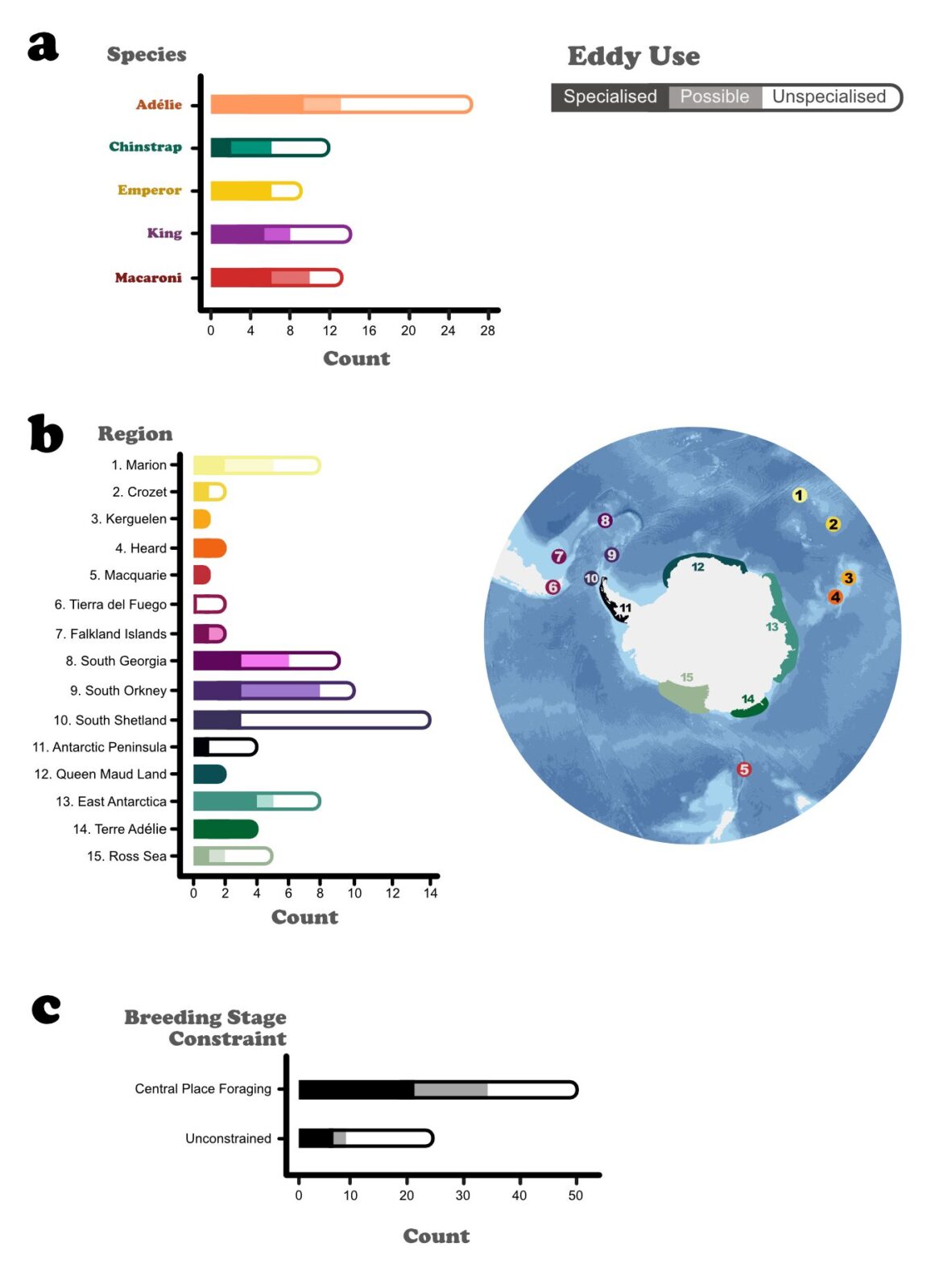
Variation of eddy usage by (a) species, (b) region, and (c) breeding stage constraints. Bar shading denotes the number of case studies classified as specialised (dark), possible use (intermediate), or unspecialised (white). Figure 4 from Wilson et al. 2026.
By diving into certain case studies in more detail, we hoped to better understand the mechanistic link between eddies and penguin movement. One such example came from chick-rearing Macaroni Penguins from South Georgia, which exhibited movement behaviour indicative of foraging around the outside of eddies and at the boundaries between eddies. This was linked to small ocean fronts which were forming in these same zones, likely because these fronts trap prey species like krill in near-surface waters, where Macaroni Penguins can access them more easily.
The distribution of eddies changed dramatically from year to year, and penguins seemed to rely more on eddy-generated fronts in years with lesser overall prey availability. However, breeding success was still reduced in these years, suggesting that eddies cannot compensate fully for large-scale climate-induced shifts in prey. Other example case studies revealed how eddies interplay with sea ice to affect Adélie Penguins, and how some eddies trap prey within their interiors and influence Emperor Penguin movements.
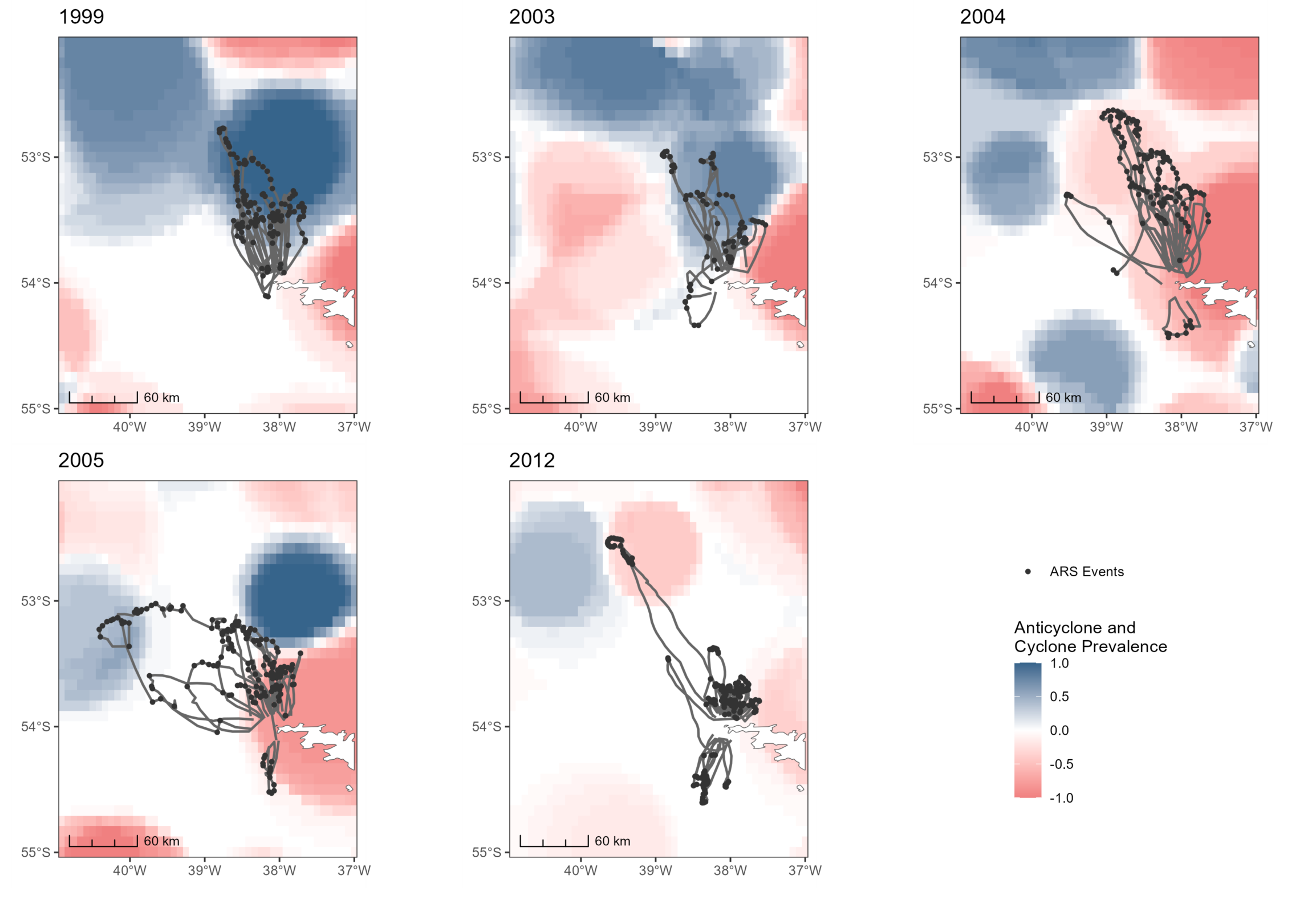
Tracks of chick-rearing Macaroni Penguins from South Georgia in the Southern Ocean. Black dots denote behaviour indicative of foraging and the blue (cyclonic) and red (anticyclonic) colouration represents the distribution of two distinct types of eddy. In this example, Macaroni Penguins are often seen travelling to the edges of eddies. Figure 5a from Wilson et al. 2026.
As climate change causes winds to intensify and sea ice to melt, eddies are becoming stronger and more abundant in the Southern Ocean. In isolation, this does not endanger penguins, which likely benefit from the local impacts of eddies. However, most mechanisms theorised to link eddies with penguin movements relate to the aggregation of prey in near-surface waters. The loss of sea ice and climate-induced shifts in prey distribution will pose a threat too big to be counteracted by the aggregative effects of eddies, and so every effort must still be made in the fight against climate change.