

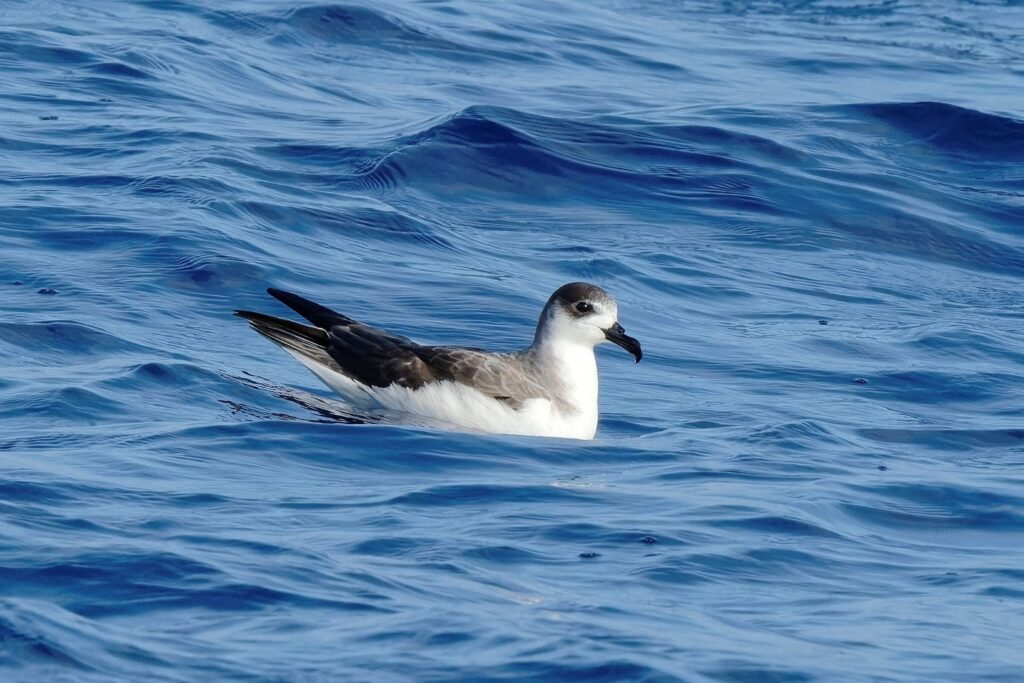
Wide-ranging seabirds present a fundamental conservation challenge: they spend much of their lives beyond protected areas and outside the boundaries of national jurisdictions. New tracking data from Juan Fernández Petrels highlight their ocean-wide movements and the potential risks they face along the way.
The study recently published in Emu – conducted by Tommy Clay of the Environmental Defense Fund and the University of California Santa Cruz, and Michael Brooke of the University of Cambridge – reveals the vast year-round distributions of this species. The entire global population, about one million breeding pairs, nests on Isla Alejandro Selkirk in the Juan Fernández archipelago, around 700 km off the coast of Chile in the eastern Pacific Ocean.
By tracking birds over two years, we mapped their movements across the Pacific Ocean for the first time. Birds were equipped with 1g geolocators, which derive geographical positions based on changes in light levels, in January 2020, and retrieved from seven birds two years later, after Covid had ravaged the world.
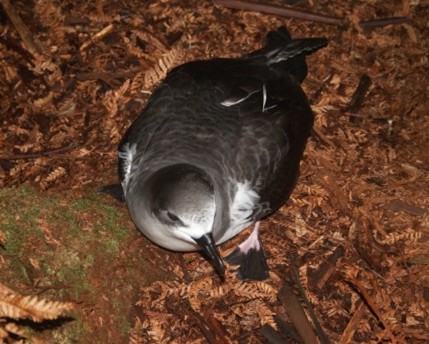
A Juan Fernández Petrel on the ground amid the tree ferns of the colony on Isla Alejandro Selkirk © Michael Brooke
During the breeding season, birds travelled thousands of km south of the colony to feed in subtropical and sub-Antarctic waters, around 5,781 and 4,298 km away, during their pre-laying exodus and incubation periods, respectively. During the non-breeding period, birds dispersed widely across the eastern and central Pacific, ranging from waters off Peru to Mexico and as far north as Hawai‘i. Rather than gathering in a single non-breeding hotspot, individuals spread out across different regions. Though our sample size of tracked birds was small, individuals showed a high degree of consistency in their migration strategies between years.
While tracking data show that actively-breeding birds are absent from the eastern tropical Pacific during their breeding season (November-May), at-sea surveys indicate that Juan Fernández petrels remain abundant in the region year-round. This is likely due to the presence of immature and non-breeding individuals, which may make up half of the total number of individuals.
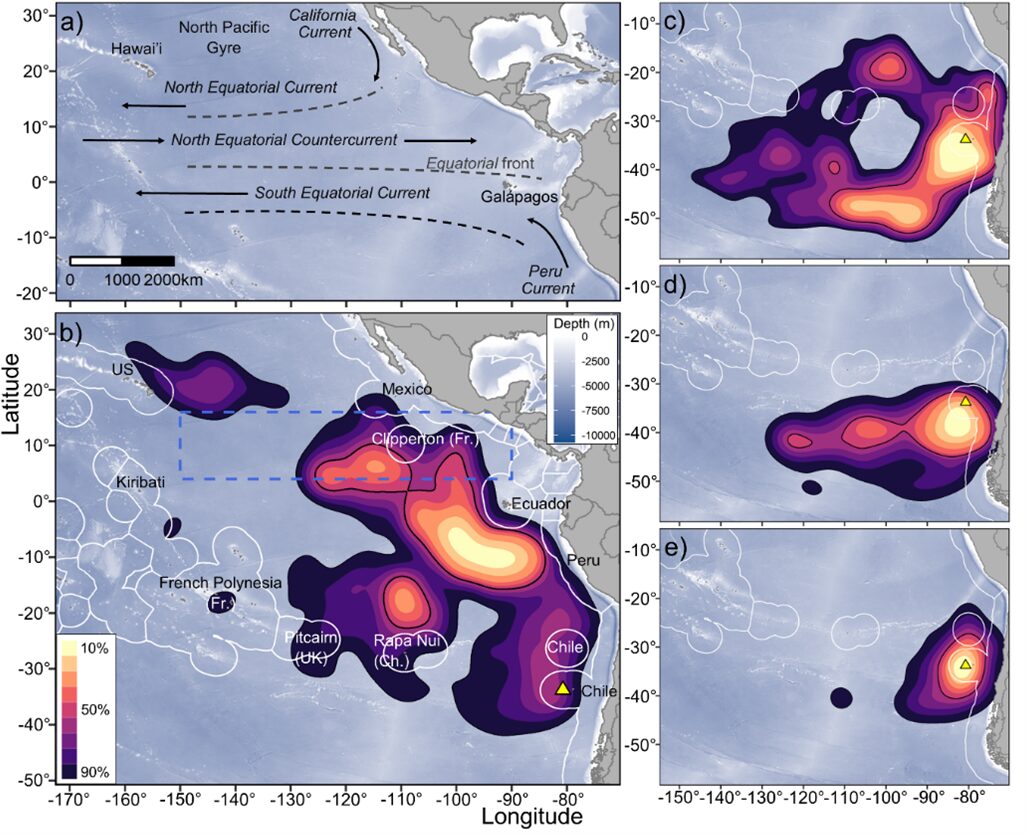
The utilization distributions (UD) of tracked Juan Fernández petrels during b) non-breeding (May-November), c) pre-laying exodus (November–December), d) incubation (December–February) and e) late-breeding (February–May) shown at 10% contours intervals. See Brooke & Clay (2026) for further details.
Crucially, much of their non-breeding distribution overlaps with areas of intense tuna fishing activity in the Eastern Tropical Pacific. While this coarse-scale overlap does not confirm direct impacts, it highlights potential for interaction. In tropical waters, Juan Fernández petrels frequently feed alongside tuna, which drive prey such as flying fish to the surface, meaning they could be affected indirectly through reduced feeding opportunities if tuna populations are reduced.
They may also be at risk of bycatch — the incidental capture of non-target species in fishing gear. Interactions with small-scale fisheries in Peru and Chile have been documented, but evidence from industrial fisheries is more limited. Given the low levels of monitoring on longline vessels, it remains unclear whether this reflects genuinely low interaction rates or a lack of sufficient data.
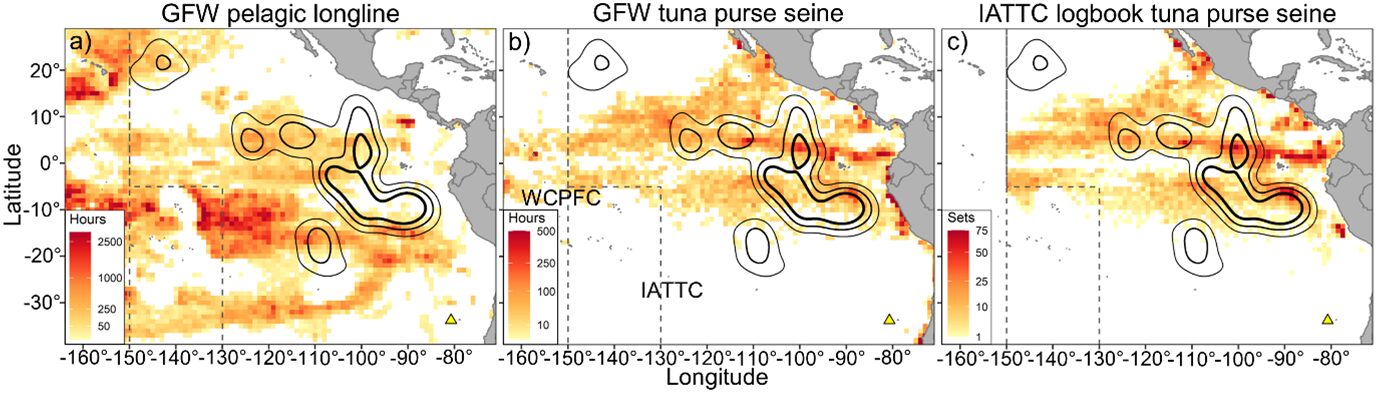
The non-breeding distributions of Juan Fernandez petrels (black lines) in relation to pelagic longline and tuna purse-seine fishing effort in the eastern tropical Pacific (yellow to red shading). From Brooke & Clay, 2026.
Encouragingly, Chile has taken significant steps to protect its marine biodiversity, establishing huge fully-protected marine reserves around the Islas Juan Fernández and Desventuradas (to the north), covering 560,000 km2. Recent plans announced last month to connect and expand the protected area to 900,000 km2 —which is awaiting ratification by the Chilean Government — would create the third-largest no-take marine protected area in the world.
These protections are important, but a glance at the petrels’ movements shows that even these vast reserves cover only a small fraction of the ocean they use. For most of the year, Juan Fernández petrels live far beyond protected waters, and during the non-breeding season, they inhabit areas where fishing is widespread.
Our study shows that for such wide-ranging species like these, conservation cannot rely on protected areas alone. It must also address the risks they face across the high seas, particularly in fisheries that overlap with their distribution. Improving our understanding of the nature of these interactions is an essential next step for effective conservation.