

Predicting how wild populations will respond to rapid environmental shifts remains a major challenge in ecology. While we know that changing sea-ice dynamics affects seabirds, the exact mechanisms connecting environmental variations to colony or population responses are often missing. To bridge this gap, we must look at the individual level, specifically through the lens of energetics, a fundamental currency that dictates trade-offs between self-maintenance and reproduction.
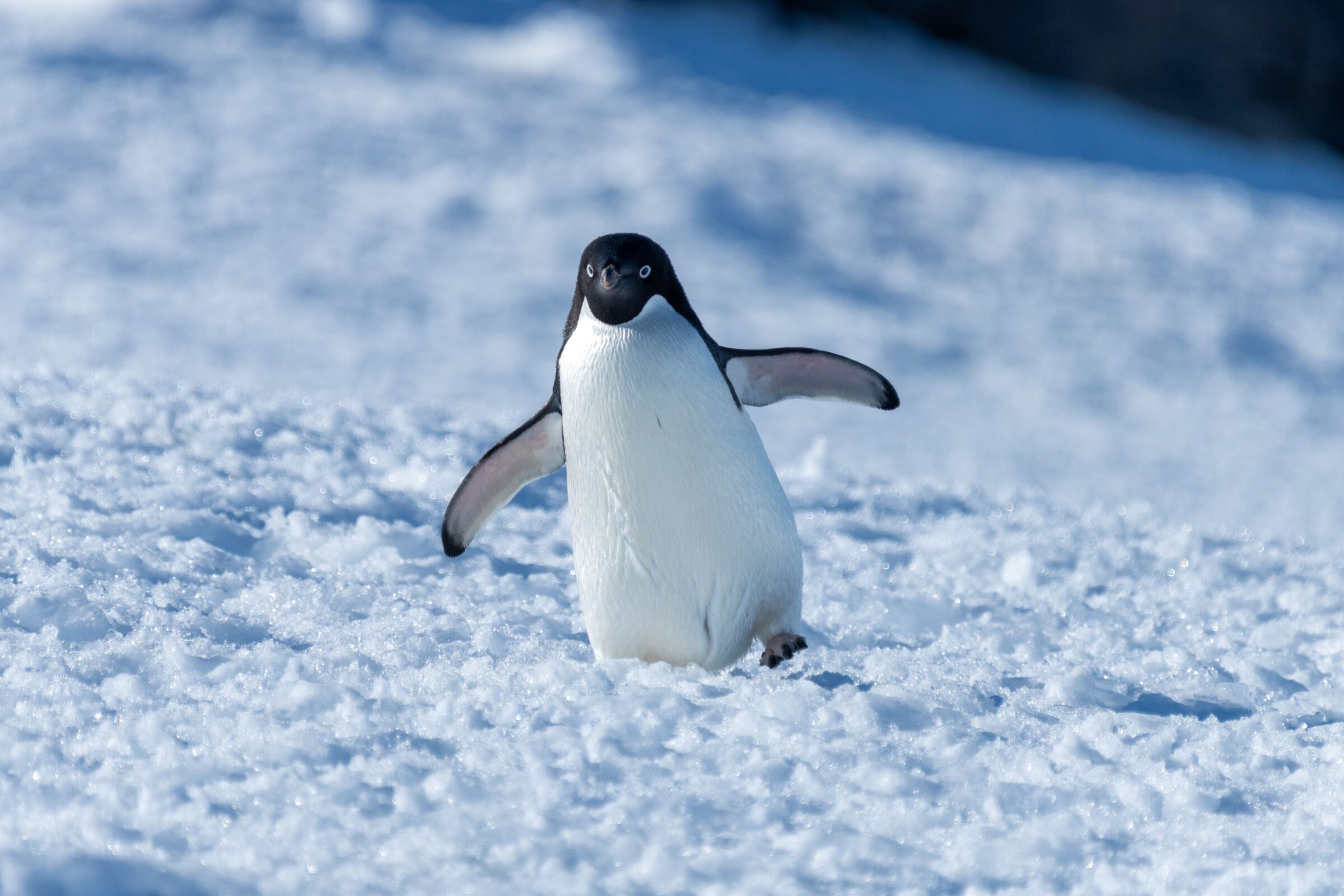
Adélie Penguin on its way to the sea. © Benjamin Dupuis.
In our recent paper in Journal of Animal Ecology, we explored this connection using a unique, bio-logging dataset spanning over 25 years. Between 1998 and 2024, we equipped breeding Adélie Penguins on Pétrels Island with Time-Depth Recorders (TDRs) during the highly demanding chick-guarding stage. By applying novel analytical tools to this long-term tracking database, we extracted at the individual-level key metrics related to foraging behaviour such as daily energy expenditure or time spent feeding, and then paired these metrics with satellite data on sea-ice conditions.
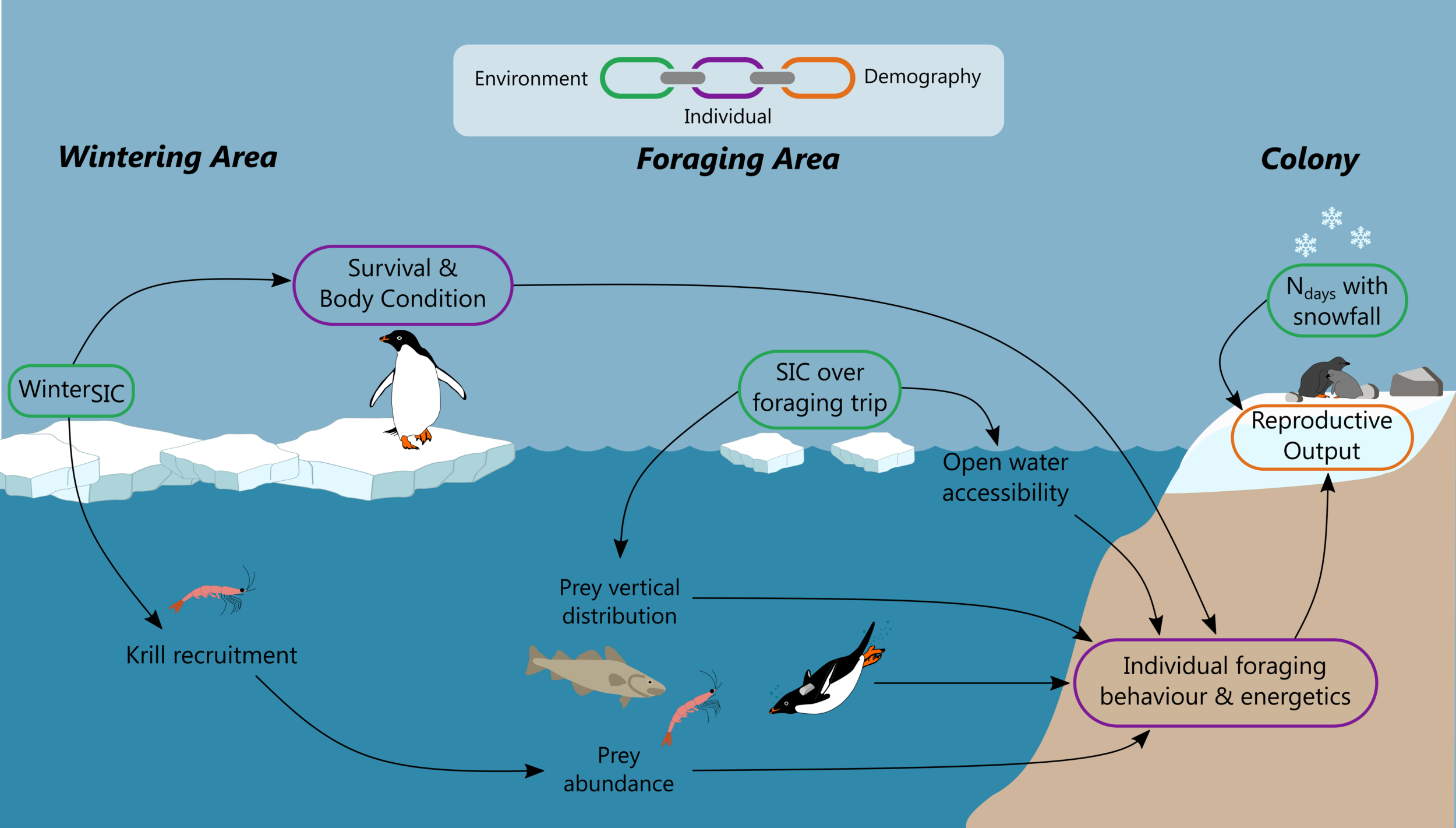
Conceptual representation of the relationships between the different variables used in this study (Fig. 1 from Dupuis et al. 2026)
Adélie Penguins rely heavily on ice-associated prey like krill and Antarctic silverfish. Hence, in the absence of direct prey abundance data, we considered winter sea-ice concentration as a proxy for prey abundance. Our analysis revealed that penguins exhibit a quadratic response to these winter conditions. Foraging efficiency peaked at intermediate winter sea-ice levels. In contrast, when the environment was particularly harsh, such as years with high sea-ice concentration and a delayed spring ice retreat, the birds paid a heavy physiological toll. Under these persisting ice conditions, parents were forced into longer foraging trips, spent less time actively diving, and ultimately displayed poorer body condition.
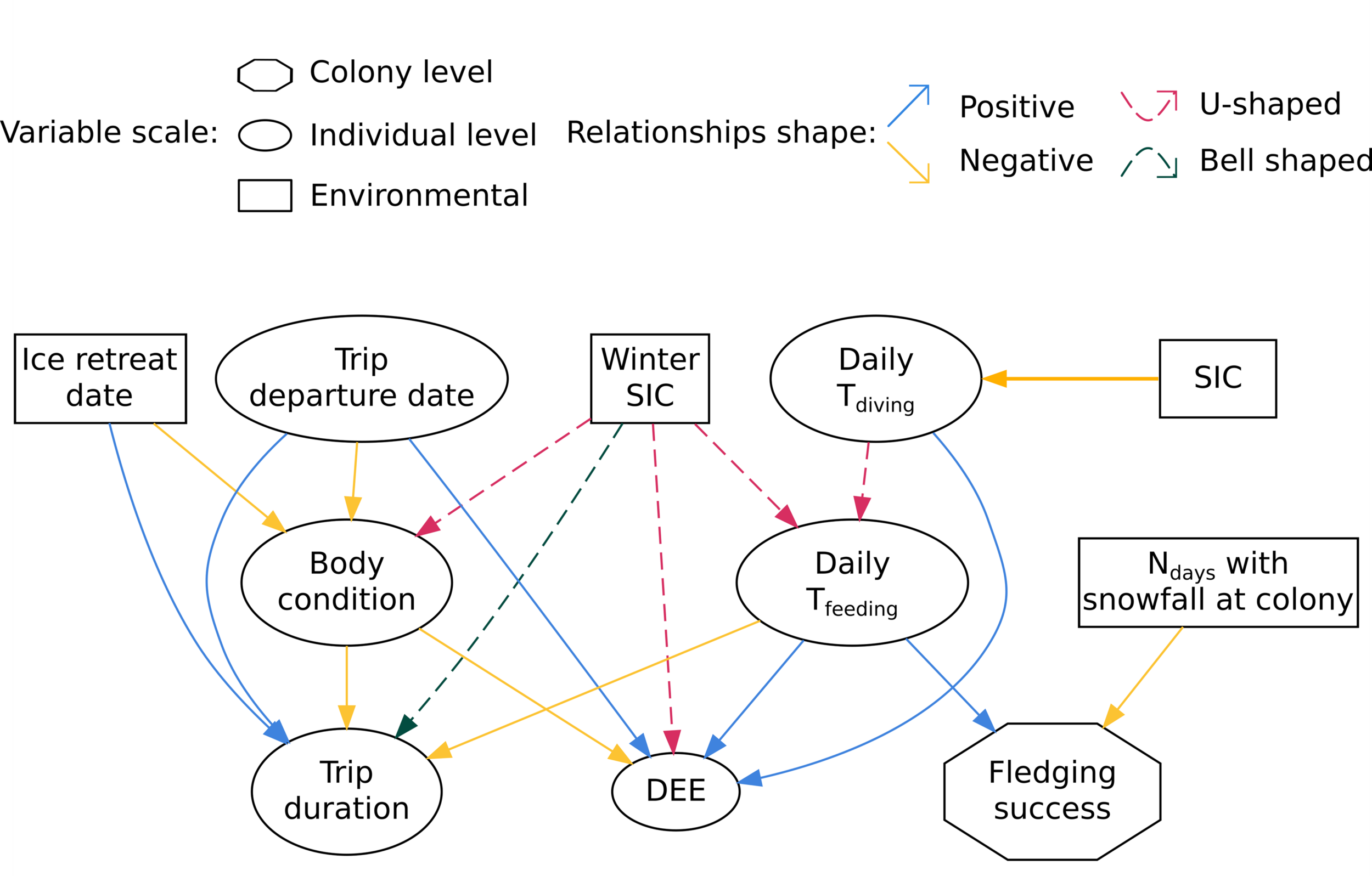
Network summarizing the different significant relations between environmental covariates, individual-level behaviour and energetics and colony-level reproductive output (SIC = sea ice concentration, DEE = daily energy expenditure). Plain arrows represent linear relationships: blue arrows represent positive relationships while yellow arrows represent negative relationships. Dashed arrows represent quadratic relationships: pink arrows represent positive quadratic relationships (referred to as U-shaped) and green arrows represent negative quadratic relationships (referred to as bell shaped). (Fig. 7 from Dupuis et al. 2026)
Crucially, these individual energetic adjustments directly scaled up to influence the demography of the entire colony. We found that parental energy expenditure itself did not directly predict breeding success; rather, the critical factor was energy intake (i.e., time spent feeding). In breeding seasons where parents sustained higher foraging effort—measured by increased daily time spent feeding, the colony displayed significantly more chicks per breeding adult reaching the creche stage.
However, the marine environment is only half the story. We also observed that on-land environmental conditions, such as increased snowfall at the colony, directly decreases colonial reproductive output independently of parental performance. Extreme events on land, such as increased precipitation, have been reported in previous studies at the same colony. In the most extreme scenarios, these events can lead to complete breeding failures (see Ropert-Coudert et al., 2015 in Ecography)
Ultimately, this quarter-century of TDR tracking establishes that individual energy constraints are crucial connection between environmental conditions and population dynamics. By mechanistically linking environmental stressors to individual energy allocation, we can greatly improve the predictive models needed to guide marine conservation in a warming Southern Ocean.