

A Landmark Moment at CMS COP15
A major milestone for seabird conservation — and for ocean governance as a whole — has just been achieved. At the 15th Conference of the Parties (COP15) to the Convention on the Conservation of Migratory Species (CMS) in Campo Grande, Brazil, governments formally adopted a groundbreaking new inter-governmental framework for safeguarding seabirds and the marine environment.
What an extraordinary moment it was to sit in the packed COP15 plenary hall, surrounded by delegates from 105 governments, more than 300 observers from intergovernmental and non-governmental organizations, scientists, and over 50 vocal representatives of Indigenous Peoples and local communities, as the gavel came down on the Resolution on “Seabirds and Marine Flyways”. “It is so adopted,” confirmed COP15 Chair João Paulo Capobianco, Executive Secretary of Brazil’s Ministry of the Environment and Climate Change — and with that, years of scientific effort and international collaboration had reached a new high point.

Aline Kühl-Stenzel taking questions at the Accelerating Conservation Action for the Ocean: Marine Flyways and Other COP15 Seabird Proposals © Barend van Gemerden
It had been a busy week with negotiations until late at night, but this Resolution was not developed here in Campo Grande – the groundwork was laid much earlier. It builds on decades of research and the contributions of more than 300 scientists to the Seabird Tracking Database hosted by BirdLife International. This science–policy journey began with seabirds tagged in remote places such as Ascension Island in the South Atlantic. Many of these tracks are absolutely extraordinary – including the Arctic Tern’s legendary figure-of-eight route across the Atlantic.
Science Behind the Breakthrough: Tracking the World’s Seabirds
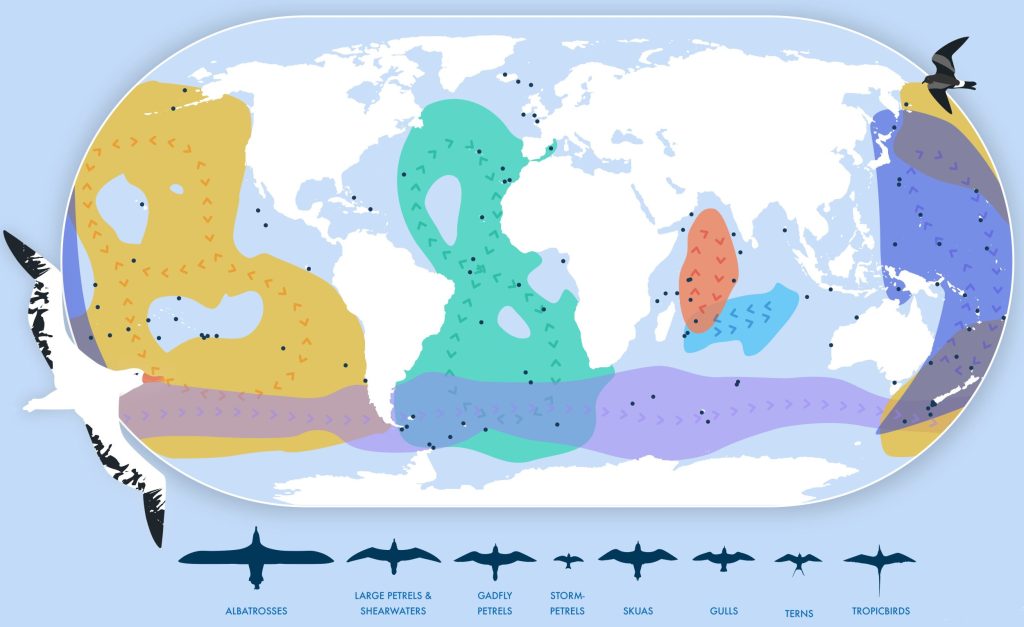
Since 2004, BirdLife has been collating tracking data to understand where seabirds travel, why they choose these routes, and what threatens them along the way. This knowledge is essential for action, enabling us and our 124 BirdLife Partners across 119 countries to target conservation action effectively. In 2023, thanks to this rich dataset, the Marine Programme identified and launched six global marine flyways — the major pathways that migratory birds take on their annual journeys, comparable to the terrestrial flyways long used to guide conservation.
On land, flyways have provided governments with coordinated frameworks for avian conservation action comprehensively since the early 1980s. They underpin entire treaties, like the African-Eurasian Waterbird Agreement, and large-scale collaborations such as the Asian Development Bank’s support for the East Asian–Australasian Flyway, aiming to mobilise US$3 billion for conservation.
Yet until now, the oceans — where many of the world’s most threatened birds migrate — lacked an equivalent global framework. Establishing the marine flyways at CMS COP15 finally closes this gap. CMS is the ideal home for this work, given its focus on migratory species and the strong overlap between CMS Parties and the six marine flyways, as identified by BirdLife. Our most recent paper, published in the Journal of Applied Ecology and released just days before COP15, mapped these overlaps, outlines why CMS is uniquely positioned to lead and outlines the potential of the marine flyways— undoubtedly helping to boost the negotiations in Brazil.
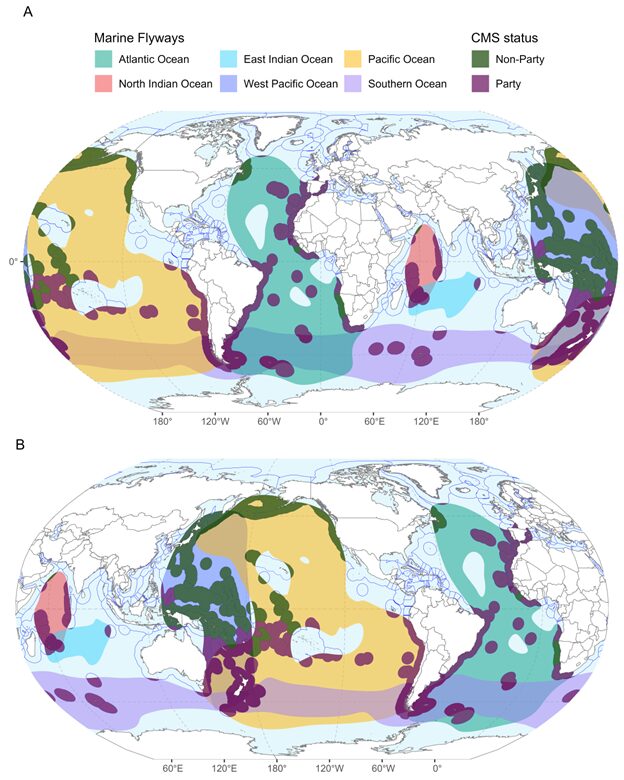
Figure 1 from Morten et al. 2026, showing the overlap of the marine flyways and national waters (Exclusive Economic Zones (EEZs) in dark blue lines). Purple coloured national waters denote CMS Parties and green represent Non-Party states. Maps are in Robinson projection, with (a) centred at 0° and (b) centred at 140° W.
What the New Resolution Sets in Motion
The Resolution sets out a clear path for what must happen next. It encourages governments to begin implementing fifteen high-level recommendations immediately: identifying and safeguarding critical sites, eradicating invasive species at seabird colonies, and strengthening awareness and capacity. It highlights key tools — such as Key Biodiversity Areas, the Marine Megafauna Conservation Toolkit, and ongoing contributions to the Seabird Tracking Database — as essential resources.
Currently, the Resolution applies only to the 121 seabird species already listed under CMS. Accordingly, Parties are also urged to propose additional species for listing on the CMS Appendices at future COPs. Encouragingly, COP15 saw the successful addition of 23 gadfly petrels and the Flesh-footed Shearwater to the CMS Appendices, thanks to a joint proposal from New Zealand, Australia, Brazil, Chile, Cook Islands, Dominican Republic, Fiji and France. To streamline future listings, the Resolution provides a “shopping list” of all 366 seabird species, including their Red List status (assessed by BirdLife), population trends and policy status. It also calls for closing geographic gaps in CMS membership — particularly in South-East Asia, North America and parts of the western coast of Africa — where ratification is urgently needed.
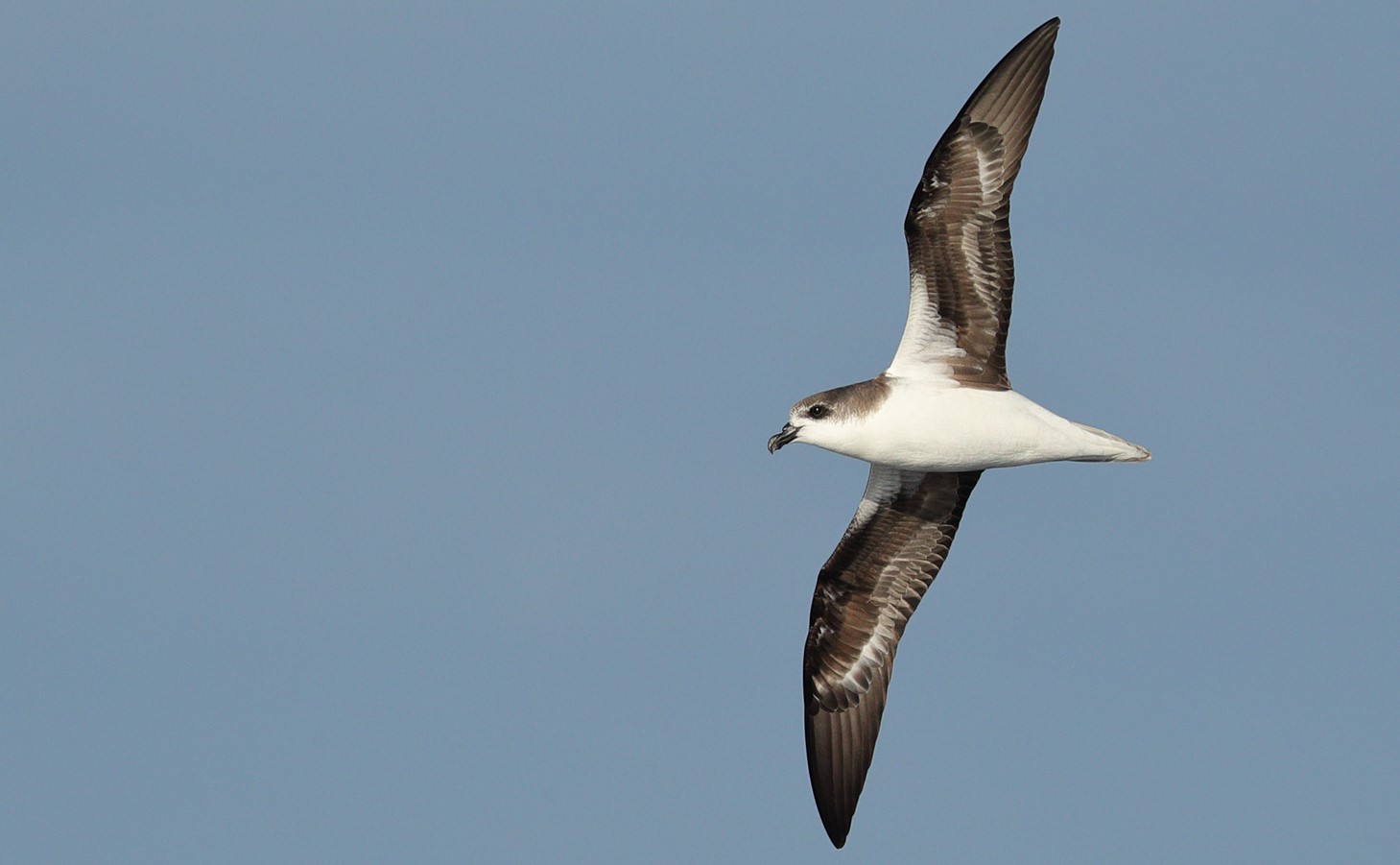
Desertas Petrel, one of the 23 gadlfy petrels added to the CMS appendices © Mike Nesbitt
Global Leadership and the Road Ahead
Australia has emerged as a champion for the marine flyways approach, chairing the technical working group that drafted the Resolution since 2024 and providing seed funding for “situation analyses” across all marine flyways, laying the groundwork for regional action. Brazil and several other governments have expressed strong interest in joining this leadership group. Countries clearly recognise that marine flyways will benefit not only seabirds but also other migratory megafauna — including whales, sharks and turtles.
Because seabirds are powerful indicators of important marine areas, the marine flyways and the new CMS COP15 Resolution will also contribute to advancing global ocean targets on area-based conservation, not least those under the new High Seas Treaty. The preparatory negotiations to kick-start this treaty took place in New York in parallel to CMS COP15, with BirdLife International also contributing here.
To explore more of what the BirdLife International delegation achieved at CMS COP15, take a look here.
To read open access scientific publications about the marine flyways see below:
Morten, J.M., Carneiro, A.P.B., …, Davies, T.E. (2025) Global Marine Flyways Identified for Long-Distance Migrating Seabirds From Tracking Data. Global Ecol Biogeogr, 34: e70004. https://doi.org/10.1111/geb.70004
Morten, J. M., Kühl-Stenzel, A., Baker, G. B., Taylor, G. A., Garcia Alonso, V. A., Jones, V. R., Crockford, N., & Davies, T. E. (2026). Using the marine flyways concept to accelerate ocean conservation. Journal of Applied Ecology, 63, e70339. https://doi.org/10.1111/1365-2664.70339