

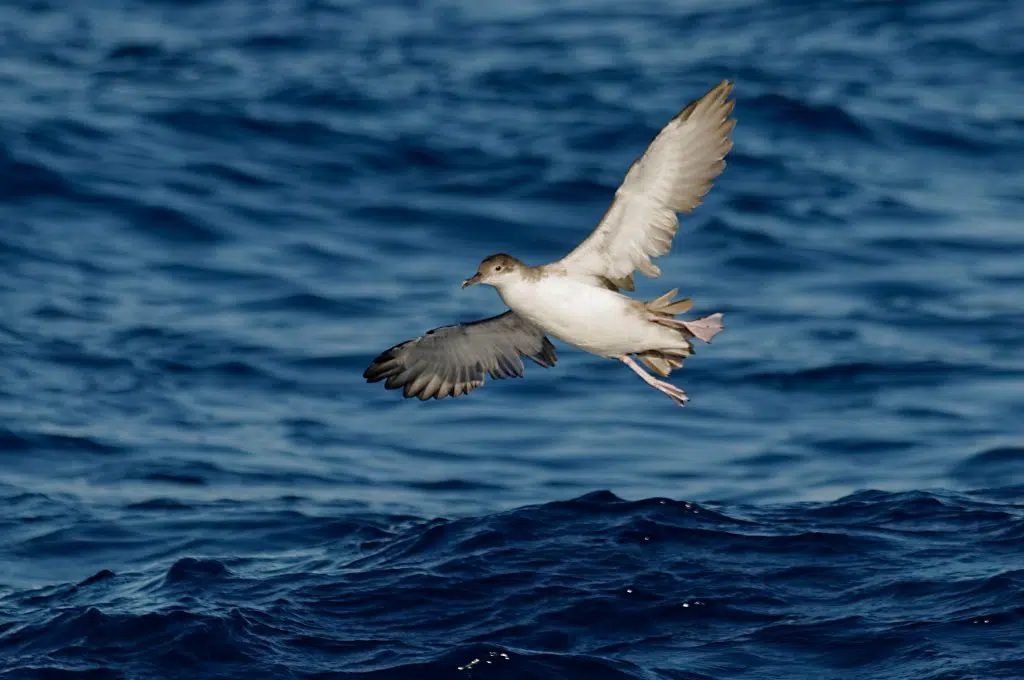
Yelkouan Shearwaters Puffinus yelkouan are endemic to the Mediterranean and Black Sea, and listed as Vulnerable to extinction on the IUCN Red List. Therefore, the species has received considerable conservation funding through LIFE projects, amongst others. Several of these projects, such as the LIFE+ Malta Seabird Project, LIFE Artina and LIFE PanPuffinus!, included GPS-tracking adult Yelkouan Shearwaters to identify marine foraging areas, then designated as Important Bird and Biodiversity Areas (IBAs) and Special Protection Areas (SPAs) under the Natura 2000 network. The data are also uploaded to the Seabird Tracking Database providing a platform for seabird researchers to access these data and analyse it further.
On Malta, which hosts globally important Yelkouan Shearwater colonies, most GPS-tracking has taken place at two of the largest colonies on the islands: Rdum tal-Madonna (RM) and Majjistral Nature and History Park (MJ). Although only ~5km apart, the colonies are on opposing sides of Malta, RM faces north-east and MJ faces west. Moreover, despite rodent control being carried out at both colonies, breeding success and fledgling numbers were repeatedly lower at MJ. To explore whether colony segregation in foraging areas could play a role in the different demographic trends, we used tracking data collected during the chick-rearing periods at both colonies in multiple seasons between 2012 and 2022.
What we found was intriguing! While shearwaters from both colonies foraged in the Gulf of Gabes in Tunisia, they overlapped less when closer to Malta. In particular, while shearwaters from RM foraged in marine areas south of Sicily, Italy, those from MJ did not frequent this area. While we know a bit more about the generalist diet of Yelkouan Shearwaters thanks to a study using DNA metabarcoding, we still do not know whether there are differences in the prey densities between the areas. Interactions with fishing vessels and availability of discards is also something we would like to look into further.
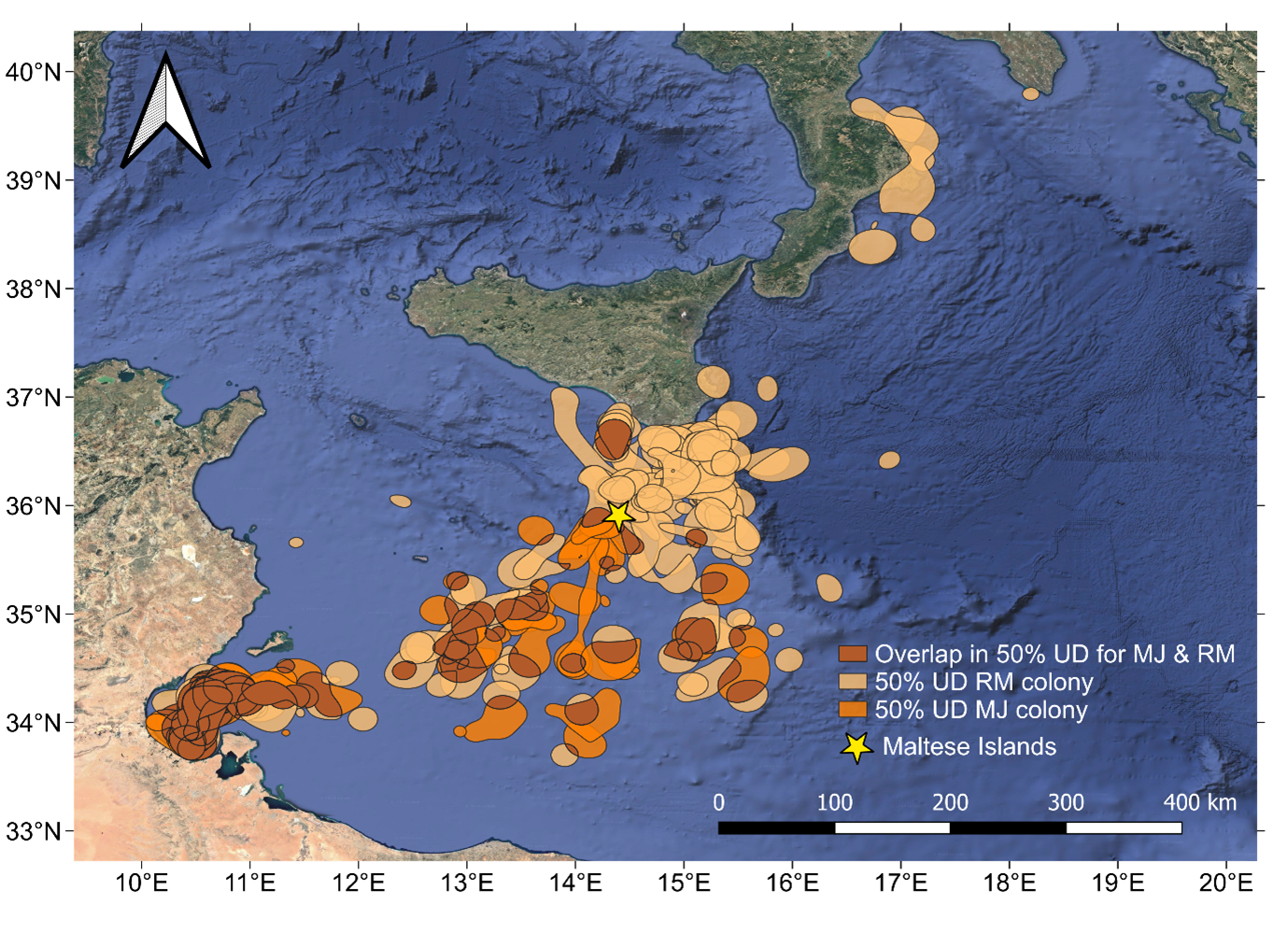
(Figure 7 from Austad et al. 2025) Kernel density areas (50% UD) for the GPS-tracked foraging trips of Yelkouan Shearwaters from two colonies on the Maltese Islands (RM – Rdum tal-Madonna, MJ – Majjistral Nature & History Park). While adult shearwaters from both colonies foraged in the Gulf of Gabes, Tunisia (34°N 11°E), the area south of Sicily, Italy (36°N 15°E) was predominantly visited by shearwaters from RM.
In the recently published paper in Marine Biology we show how MJ shearwaters made longer foraging trips, travelling further from the colony and on average stayed away for more time. We also measured the hormone corticosterone and stable isotopes of Nitrogen (δ15N) and Carbon (δ13C) in the feathers of Yelkouan Shearwater fledglings. These measurements can be used as a retrospective proxy for the provisioning the chicks received when in the nest and fed by their parents. The chicks at RM had higher δ15N values than those at MJ, indicating more frequent food provisioning, in line with the shorter trips made by the adults. At the colony level, the average corticosterone and stable isotope values in chicks was correlated to breeding success (nest survival). The result indicates that the discrepancy in breeding success between the colonies is linked to differences in foraging and provisioning.
In a worrying twist to the story, we also found that fledglings that failed their first flight from the colony had experienced poorer provisioning during chick-rearing. Every year, several young shearwaters are found grounded in coastal urban areas, presumably disoriented by light pollution on their first flight. These fledglings had disproportionally higher corticosterone and lower δ15N values. Nutritional stress during growth could have led them to fledge prematurely before they attained strong flight capabilities. In turn, this would make them prone to collision and exhaustion during light pollution attraction.
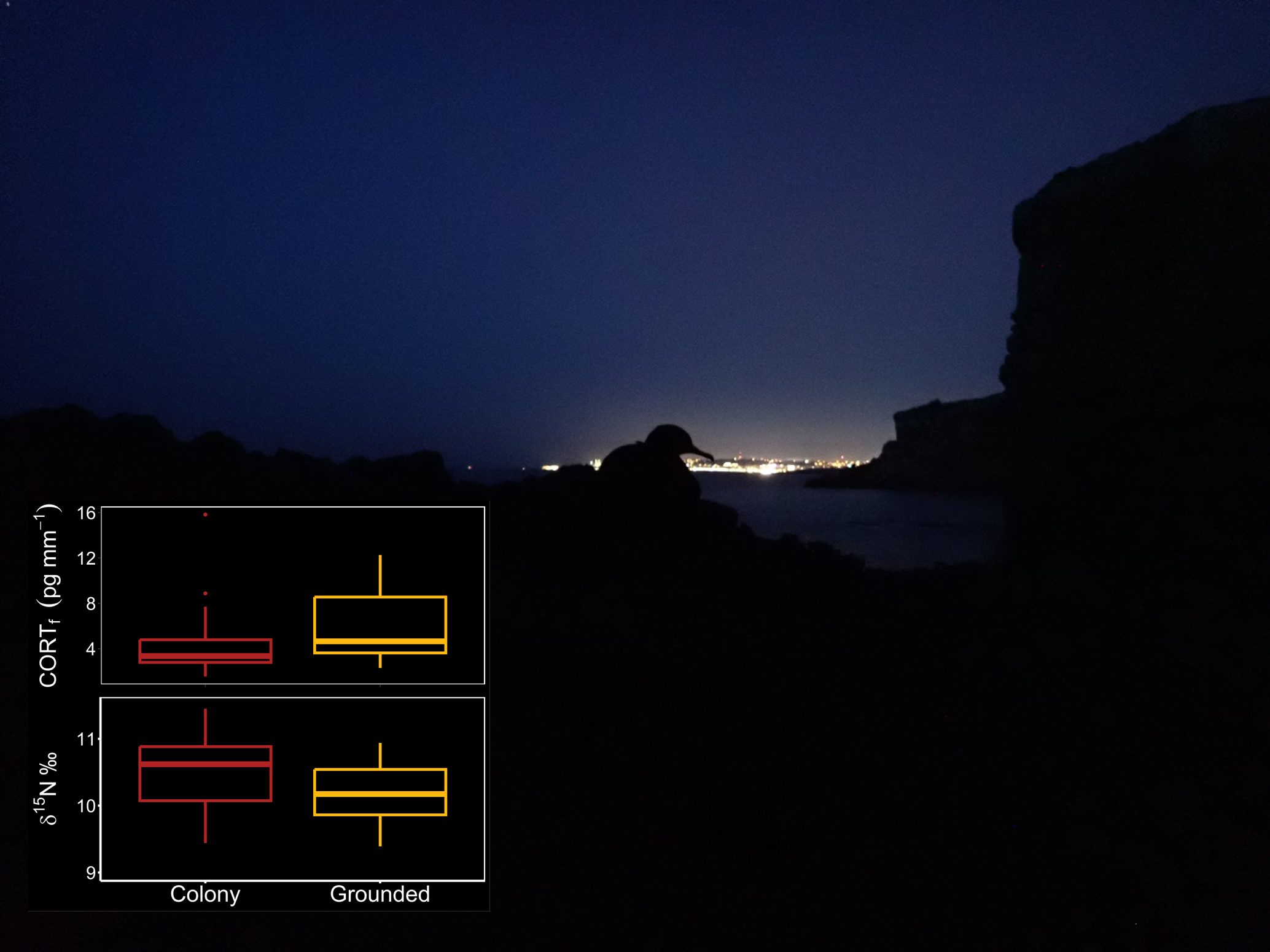
A young Yelkouan shearwater leaving the colony, faced by the disorientating coastal light pollution. Inset: Disproportionally higher feather corticosterone (CORTf) and lower stable isotope values of Nitrogen (δ15N), indicators of poorer chick provisioning, measured in fledglings grounded in urban areas compared to the wider cohort at the colonies.
Together the results from this study, call for improved protection of marine resources, which should ensure plentiful fish both for foraging shearwaters and long-term sustainable human use. While shearwaters are efficient ocean travellers, during the chick-rearing period they need good foraging conditions, that are not too distant from their colonies, to be able to feed their chicks frequently.