


Over a decade ago, I attended a biologging conference and was surprised (and a bit disappointed) by the overwhelming proportions of talks related to tracking seals. Of all the possible animals one could track, seals were taking the front spot.
Over the years, I attended many more conferences, mostly related to seabirds, and every time I had this same feeling: presentations revolved around a few species, while others were totally neglected. Then, in April 2025, I had the honor to work with Jenn Lavers and Alex Bond from Adrift Lab while undertaking field work on Lord Howe Island. During one afternoon chat, these discrepancies in species representation at conferences came up. That was the starting point of our recent paper published in Biological Conservation.
We reviewed 2962 abstracts from 30 seabird-focused conferences held between 2015 and 2025. For each abstract, we recorded the seabird species mentioned and the main research topics of the study (up to three). Our gut feeling was right, some species are over-mentioned (more than two standard deviations above the mean; n = 16; Figure 1), while some species are under-mentioned (n = 70) or not mentioned at all (n = 70). Working mainly with Leach’s storm-petrels (Hydrobates leucorhous), one of the over-mentioned species, I’m just as guilty as other seabird researchers in this discrepancy!
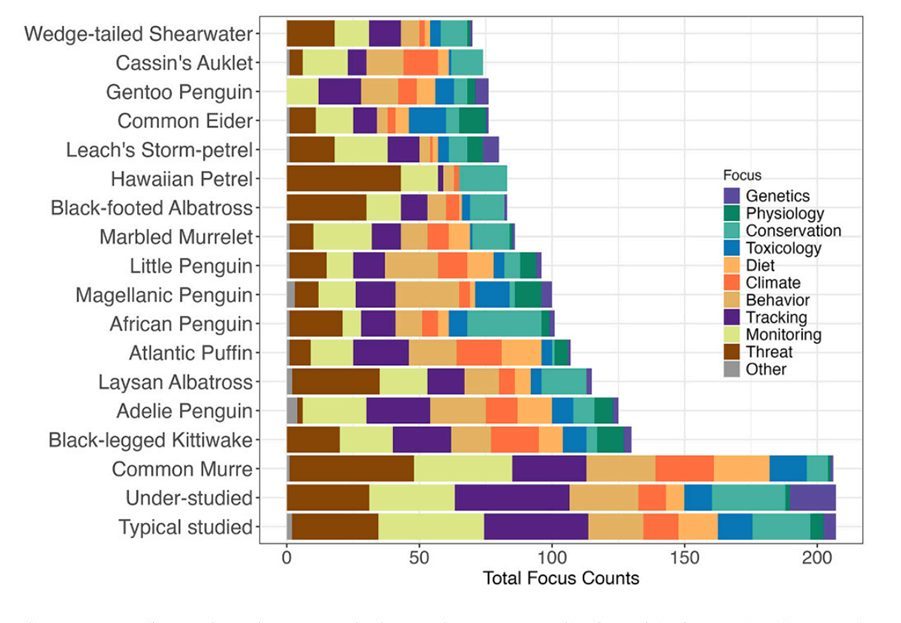
Figure 1 from Pollet, Bond and Lavers (2026): The number of mentions of overstudied seabird species (n = 16) in conference abstracts. Each research focus is represented by a different colour. The under- and typical- studied species are added for comparison (bottom two bars and scaled to match that of the Common Murre).
Monitoring, tracking and threats were the most represented research topics, and for each of those topics, the most reported species was Common murre (Uria aalge). In general, penguins and auks were the two families with the most over-mentioned species (as a percent of the total number of species within that family). South America and Australia were the regions with the most never-mentioned species.
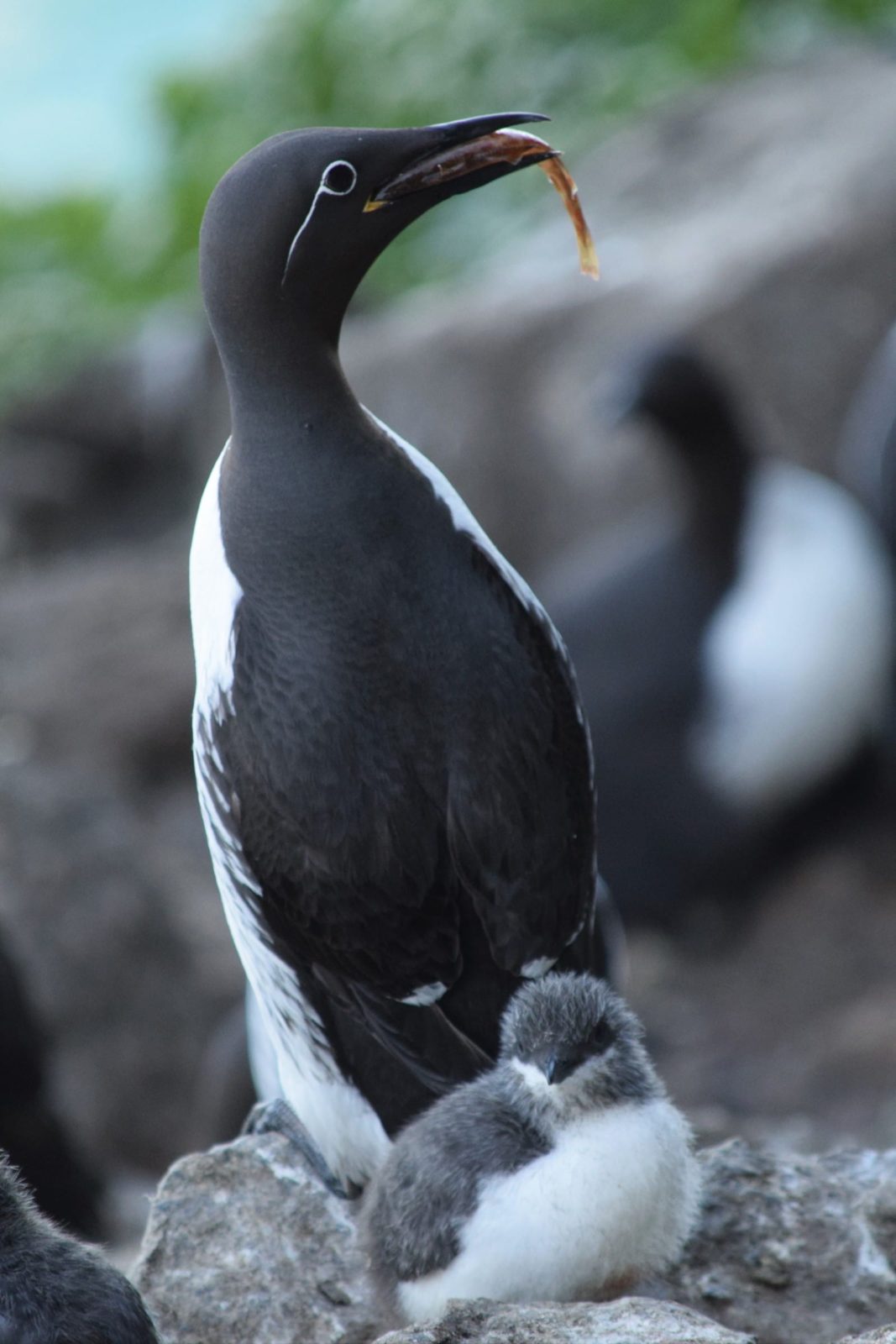
Adult Common Murre/Guillemot with fish and chick (by Beth Clark)
What does all of this mean? Conferences are meant to be places where we take the pulse of a field: what questions we are asking, what tools we are using, and which species are shaping our collective understanding of the marine environment. If that pulse is dominated by a small subset of species, then our perception of seabird ecology and conservation may become skewed. This is not to say that over-mentioned species do not deserve attention, many are important indicators, model systems, or conservation priorities. But this discrepancy can leave gaps in knowledge, particularly for species that are harder to study, or located in regions with fewer resources.
I do not think these patterns result from a lack of interest, but rather they reflect practical constraints: funding availability, access to colonies, and established research programs. Still, recognizing these biases is a first step toward addressing them. This paper is not meant as a critique of individuals, but as an invitation to reflect on how our field collectively allocates attention. If we want a more complete and equitable understanding of seabirds we may need to look beyond the usual suspects and give the spotlight to the species that have been quietly overlooked.